Showing posts with label Whistler Radar Detectors. Show all posts

Sunday, December 07, 2014

Whistler: A lot more than just a Radar Detector Manufacturer

During my visit to SEMA this year, I visited Whistler's booth and was surprised to learn that in recent years, Whistler has been evolving as a company that produces a wide range of appealing and practical consumer electronic products beyond merely radar detectors.

Whistler now offers some great products that every owner of an automobile should seriously consider having in their trunk or glove-box.

Whistler MotoGlo Helmet Safety Light


For motorcycle owners, Whistler offers a very interesting safety enhancing product called the MotoGlo Helmet Safety Light.  This unique product enhances safety by essentially giving the rider the equivalent of a CHMSL and directional indicators for a motorcycle.  At less than $100, it's cheap insurance.

Whistler Portable Cup Holder Power Inverter


Whistler also offers a wide variety of power inverters of varying size and capability--including some very portable ones that can attach to your in-vehicle's 12v cigarette lighter outlets--to power a variety of 120v electronics.  The small sizes of many of their models coupled with their low price points make them very compelling alternatives to other manufacturers' power inverters.

Whistler Jump & Go Portable Jumpstart and Power Supply
 

Their innovative Jump & Go portable jump vehicle starter and power supply kits have to be seen to be believed.  Imagine holding the power of an emergency car battery in the palm of your hand.  Well you don't have to.  Whistler makes it a reality.  No longer do we have to carry heavy and large jump starters.  Beyond vehicle starting, these kits can be used as portable power supplies that can be safely taken in the wilderness.  Every road warrior or outdoor explorer should own one of these--especially at their price points of less than $100.

As the holiday season is upon us, both the Jump and Go, MotoGlo, and their small(er) inverters make great stocking stuffers! Something that I am doing for my own family members.

For scanner fans, Whistler offers a full-range of technologies in both portable and base-unit models that, I believe should merit serious consideration.

Sure, Whistler continues to offer great value-priced radar detectors like the CR85 and CR90, but you should know that today, Whistler is a whole lot more than just a radar detector manufacturer.

Give 'em a look, you'll like what you find.

Whistler Group Official Manufacturer Web Site

Wishing everyone a Blessed Christmas and News Year's Holiday

Veil Guy

Saturday, January 25, 2014

Whistler CR90/CR85 Review: The best values going in radar detectors today.

Whistler CR90

Updated: 1136Z-5, 19 Apr 14, By Veil Guy

Whistler CR90 & Whistler CR85: The best values going today.

Whistler continues to impress me with their continued offerings of budget-valued radar detectors that offer subtly powerful capabilities beyond what their price points would otherwise suggest and without over-the-top marketing promotions.  The Whistler CR90 along with its little brother the Whistler CR85 is no exception each available at less than $180 and $150, respectively.

Like their predecessors, the Whistler Pro-78SE/XTR-690SE, the Whistler CR90 and CR85 sport a large non-reflective aquamarine-colored OLED display that is readable in all lighting conditions and is accompanied with voice alert augmentation identifying detected bands.

Whistlers have the unique ability of displaying GPS time--something more useful to read than merely the sensitivity setting as is typical of other radar detectors.  Both models are attractive and have a low-reflectance black plastic chassis.  My early production model's power cord had a tendency to come apart but I understand later models come with ones that do not.

The Whistler CR90 represents Whistler's first GPS-enabled windshield-mount radar detector which provides a national database of red light camera and speed photo enforcement locations.  The Verilight™ database is frequently updated and can be easily downloaded to your detector using the USB cable that is provided and an Internet connected PC.  Unlike the Whistler Pro-3600 which required a USB-key drive to update, the CR90 can be updated using Whistler Database Update Tools that is downloadable from their website.  Getting the program to work requires removing the file extension of .htm to execute.  But once that is done, the program can be run directly without having to be installed like most other Windows applications.

To reduce the likelihood of alerting to data points that are not associated with your route, the Whistler CR90 allows you the distinct ability to reduce the GPS alerting radius to essentially eliminate GPS alerts when driving on an adjacent highway or road--something that can occur on all other GPS enabled radar detectors.  While one can mark locations of known speed trap locations (such as VASCAR), the Whistler does not allow for GPS-lockout (auto muting) of stationery radar sources like those emanating from door openers or drone signs.

Reception to Ka-band continues to be exceptional and while X-band and K-band detections tend to lag somewhat as do off-axis detections--relative to other manufacturers higher-end models (costing twice as much or more)--they should be sufficient for most drivers.  Like previous models, the Whistler CR90 can display Ka-band frequencies of police radar at 33.8Ghz, 34.7Ghz, and 35.5Ghz to allow the driver to instantly differentiate a legitimate Ka speed trap from a Ka-false occurring at another Ka frequency that can occur when in close proximity to another radar detector in another vehicle.

Laser sensitivity is also very good and is better than windshield mount detectors of other manufacturers that cost nearly three times as much.  Since Whistler also caters to an international clientele, their detectors can alert to difficult-to-detect police laser guns used both abroad and in the U.S. that other detectors simply can not.  These models include the LTI TruSpeed S, Laser Ally & Dragoneye,  Laser Atlanta Stealth Mode, and the Laser Atlanta Torch w/Stealth Mode II.

Their increased sensitivities to laser also makes the CR90 and CR85 (non GPS model) more likely to alert to lidar-based vehicle accident avoidance systems such as those by Toyota and Infiniti.  Fortunately, these systems are readily identifiable because Whistler also has the unique ability to determine and display laser pulse rates along with their laser detections, which allows for locking them out at a push of a button.  As Whistler's engineering identifies more of these newer systems, future firmware versions will have these these pulse rates already locked out by default.

Without question the most menacing new development on the roads is the explosive use of vehicle K-band lane departure systems.  These rolling sources of RF interference often wreak havoc on radar detectors and the CR90/CR85 are by far the most adept at filtering these obnoxious systems in a manner that has the least adverse impact on K-band reception.

Unlike other radar detectors which can add a second or two delay to alerting to K-band detections to reduce false alerts from these types of systems (and with only modest results), the Whistlers allow for incremental timing delays that were effective in eliminating the systems I encountered.   Whistler also uses a similarly configurable feature (TFSR) to effectively filter out stationery K-band and X-band traffic flow sensors that can be found on certain highways throughout North America.

Whistler has for a long time valued the importance of having quick reacting detectors which can allow them to alert sooner to an approaching radar trap than slower and more sensitive ones.  But for the first time, these new Whistlers also have the unique ability to have their reactivity to Ka-band manually adjusted in fine increments to further reduce Ka-falsing, while maintaining their high sensitivity, independently of the X or K band.

Whistlers are the only ones ever made that allow savvy owners the ability to directly alter the reactivity (speed) of detections.  This is especially useful because I prefer a detector, even potentially a less sensitive one, that can alert to brief appearances of police radar--such as those from instant-on or quick-triggered radar--than a more sensitive one that is intentionally slowed that may not.  This makes the CR90 and CR85 very special, indeed.

The CR90/CR85 both continue to provide the best city modes available on any detector.  When CITY mode is selected, sensitivity is unchanged from HIGHWAY mode, but the alerting tones to X and K sources are more mild and brief.  CITY 1 and CITY 2 modes increasingly reduce sensitivity for driving in an area that has a lot of stationery sources of radar falses, such as door openers.  These configurations and the fact that the Whistlers don't alert to extreme off-axis detections also makes them well suited for driving around town.

With respect to product packaging, I feel it is high time for Whistler to provide a nice carrying case.   In my opinion, these detectors are too nice not the provide their owners a safe way of storing them or taking them along to the airport.

In conclusion, I found the CR90 to be an absolute pleasure to drive with, allowing for eminently usable configurations simply not possible with any other radar detectors.  The CR90 and CR85 are without question the best values currently on the market.  Either one should definitely be on your short list.

Happy and safe motoring!

Veil Guy

Recommended purchasing sources (please support them):

Related Article:

Whistler CR85/CR90 Preview

Tuesday, July 02, 2013

Whistler CR90 Review/Preview: Whistler 3600 for the Windshield

Whistler CR90 Review/Preview: Whistler 3600 for the Windshield

 
Whistler CR90

Read the full Whistler CR90 review.

Those of you have been following my reviews and articles over the years already know how much of a fan I have been of Whistler.  My support for this company and its value priced models began the day I witnessed a $120 Whistler windshield mount radar detector spank a very expensive remote installed detector (sold by a company with a letter followed by two numerals).  Up to that time, I had considered Whistler, quite frankly, an also ran.  In reality, I couldn't have been more wrong.

Since that time, Whistler's engineering has continued dazzling me with more improved offerings, year after year, of value-priced over-achievers.

A couple of years ago, I had the pleasure of installing Whistler's first GPS-capable remote radar detector, the Whistler Pro-3600, into my wife's Subaru and since that time, we have been well-served with its capable radar, laser, red light, and photo enforcement alerts as well as all the capabilities that I have come to expect from the addition of GPS.

Had it not been for some legal disputes that tied up several detector manufacturers--we likely would
have seen this detector sooner rather than later.

With the Whistler CR90, it is nice to see that the GPS-circuitry is all internal and I personally find the revised chassis more attractive than the Whistler Pro 78-SE models that the Whistler CR90 supersedes.  I say the Pro-78 series because the display will be the same high quality OLED blue display found on that most recent model. 

Unique to Whistler is verbal augmentation of RSID.  In other words, the detector can be configured to verbally indicate a specific Ka frequency, such as 35.5.  The CR90's power cord includes a secondary USB connection to power smartphones, such as an iPhone, a very handy thing, indeed.

Performance wise, nothing really new here, so I would expect essentially the same detection ability to radar and laser as the most recent SE series of detectors.

The CR90's GPS database can be quickly be kept current however the unit will need to find its way to your laptop or PC as it does not directly mate with a USB thumb-drive like the Pro 3600.  Beyond the preloaded GPS database, the CR90 supports about 1000 custom user-marked locations.

Unlike Escort and Beltronics, the Whistler comes preloaded with the GPS and doesn't require an annual renewal fee to stay current.  This makes these new radar detectors from Whistler even greater compelling values.

The suggested retail price of the Whistler CR90 is set at $279.95 USD.  The street price is surely to be less.  Expect to see the CR90 to begin shipping mid later this month and I expect to get my hands on one for an early review sometime before that as has been typical with Whistler's previous models.  Until that time, I am pleased to see that Whistler has imbued a windshield-mount radar detector with the same capabilities as their venerable Pro 3600 remote.

Happy and safe motoring!


Sunday, October 21, 2012

Whistler Pro-78SE/XTR-690SE Review: Whistler's best gets even better.

Updated: 23 Apr 14, By Veil Guy
 
Whistler Pro-78SE & Whistler XTR-690SE Review:   


Darwinism is alive and well at Whistler Group.

Those of you who have been long-time readers of my blog already know that I've been a huge fan of Whistle and this particular Whistler review has been long overdue.

Whistler's product development team has always been openly receptive to customers' [and reviewers'--ie; my] feedback for improvements and they continue to offer great performance for terrific value.

Historically, when an updated model has been introduced, there have been genuine evolutionary improvements in performance and/or features. So, it is of no surprise that the latest Whistler Pro-78SE and Whistler XTR-690SE models continue to inure in this vein.

As has been the case for some time, I have been privileged to receive an initial production model of the, (finally!) soon to be released, revised Whistler Pro-78SE for review.

These updated Whistler Pro-78SE and Whistler XTR-690SE models offer some welcomed improvements, not so much in terms of raw performance (sensitivity) increases, but in their refinements, resulting in radar detectors that are much easier to live with.

The timing of this could not have been better as my wife and I went on a business trip to southern California, affording me the opportunity to put the new Whistler Pro-78SE through its paces, in what I have come to regard as one of the more challenging areas in North America to drive with a radar detector.

So, what are these improvements, you might be asking yourself?

Well, for starters, I am thrilled to report that those annoying Ka9 falses that some Whistler owners have been complaining about over the past several years seem to have finally been excised.

It was only when a good Samaritan West coast forum member [named Freebird] and myself volunteered our time to explore the greater Los Angeles area, last year, in our vehicles and armed with specially modified detectors, that the sources of this interference were ultimately identified.   Our collective feedback enabled Whistler's engineering team to address the issue.

As it turned out, many of these newly identified RF sources were wreaking havoc within certain Whistler models (and potentially other brands as well). Even though certain Whistlers alerted with urgent levels of Ka, the frequency interference did not actually occur within the Ka-band.  

It is very important to note that during which time the effected Whistlers were being interfered, they would not necessarily alert with a Ka9 false, however their reception performance to genuine Ka-band was adversely affected, sometimes substantially so.

It is this dynamic that caused the apparent discrepancies in performance that were observable to those driving in the afflicted areas.  This was in stark contrast to the high performance levels that I had experienced on my driving routes, since my models were not inhibited by those sources of interference.

I am pleased to report that during my recent travels to both San Diego and Los Angeles, Whistler was ultimately successful in this endeavor. While this type of interference seems to have occurred in specific areas, those affected will greatly appreciate the modification, as they will now be able to experience the Whistler in a more consistent fashion.

Speaking of Ka-band, reception performance to Ka continues to impressive the heck out of me, particularly with Ka-Max mode setting.  Especially now, this mode will be of much higher utility for those who were experiencing the kind of "falsing" mentioned above, since high sensitivity and quick responsiveness now comes without the accompanying headaches.

Whistler also went to great lengths to eliminate more unconventional sources of K-band falsing.

Just as Escort/Beltronics and Valentine Research have developed methods for filtering out traffic flow sensors that are adorning some highways, so too has Whistler with the incorporation of a new filtering mode, called TFSR (traffic flow sensor rejection).

Whistler has informed me that the TFSR feature will also effectively reduce K-band falsing from new crash-avoidance systems of certain German vehicles employing either pulsed or frequency modulated K-band radar. 

This is a really welcomed new capability, as having driven behind certain Audis that continue to wreak havoc with other radar detector brands.

In the case of many traffic flow sensors, these pesky devices typically transmit for a duration of approximately 500ms (1/2 second) at intervals of 30 seconds or one minute. The problem is that proximate conventional radar detectors not only repeatedly false to K-band, but they false in a manner that mimics genuine instant-on radar--something that is very disheartening to the unsuspecting motorist.

In my recent travels, I found when Whistler's TFSR filter was enabled, the Pro-78SE effectively eliminated falsing in all but a couple of instances--when I was located in proximity to two sensors that fired in close succession. Fortunately Whistler provides the ability to add a finite amount of additional filtering to TFSR with the selection of the increased FILTER modes. When TFSR and FILTER 1 are enabled together, all falses from these sources appeared to be eliminated.

As with any increase in filtering "delay," one has to consider this double edged sword for the bands affected by such a feature as it can increase the likelihood of ignoring a quick trigger. Such is the case for the TFSR mode in that there is a minimum length of time the X or K band signal needs to be available for qualification in order to ignore the pulsed traffic flow sensors mentioned above. This additional delay appears to be not as long as some other brands offering a “traffic sensor rejection” feature. Ka band is not affected by the TFSR feature. [more on this in a future article]

I have come to really appreciate Whistler's CITY mode. Unlike other detectors, which wean effective reception performance to X-band (and perhaps K-band) when selected, Whistler provides three city modes.

The first mode, doesn't affect apparent sensitivity at all, it merely alters the nature of the detector's alerts. Instead of receiving typical X-band and K-band alert tones, at varying Geiger rates, CITY mode alerts with two quick high-pitched tones and then immediately goes to mute on the alert.  If and when the signal strength is high enough, reminder tones will briefly alert.  I really came to appreciate this feature driving on the high-density highways of southern California.   No more needing to reach over to mute these annoying alerts.

CITY1 mode reduces low level alerts to X-band and CITY2 model eliminates X-band alerts entirely. Think of CITY mode as HIGHWAY mode with alternate alert tone sequences.

The one drawback, in my opinion, is that all radar bands alert in this fashion, including Ka-band. The thinking there was that in high-density areas, there is a greater likelihood to encounter [cheap] radar detectors for extended periods of time [like in heavy traffic] that can cause falsing to Ka-band.

My preference would be for the CITY mode to only affect X-band and K-band, the predominate sources of falsing around town, and reserve Ka-band to the other modes of FILTER1 and FILTER2.

Another area of reception that I would like to see improved, is the rate of falsing to X-band and K-band sourced around town. In an apparent contradiction to itself, even though the sensitivity to both X-band and K-band is less with the Whistlers than higher sensitivity models from Escort and Beltronics, the rate of falsing was greater even when driving with the Escort 8500 X50 Black, in highway mode, in those same areas.

This occurs, I believe, because the Whistlers X and K band coverage is wider than that of the more expensive Escort, Beltronics, and Valentine models causing them to alert to X and K that is just outside of the tolerances otherwise required.


Behold a thing of beauty

The new Whistlers now feature a high-end display.  Gone are the LED displays of yesterday. Instead the new Pro-78SE and XTR-690SE now utilize OLEDs and in my opinion, they are the nicest displays that I have yet seen on any dash mount radar detector.  

One of the mild criticisms that I have made over the previous years of the blue and red LED displays was the size and appearance of the displays' plastic covers. In my opinion, they were excessive and looked disproportionally large. In their place is a screen that utilizes an anti-reflective coating that when coupled with the OLED screen makes for the most impressive viewing experience ever.

Even in direct sunlight, the display was easily readable and in the evening, the aquamarine-blue pixels were very easy on the eyes, unlike the displays of blue LEDs. You've got to see it to really appreciate it. The text is quite large too, making it very easy to read, even for my aging eyes. I expect the XTR-690SE to be equally impressive in RED.

I can only speculate that a multi-colored OLED display is in Whistler’s future. In my opinion, this would be a welcome addition line and something that I have been wishing for a good number of years.

Don't expect to see any price increases for all of these improvements. Expectations are that these new models should begin shipping in the coming weeks.

For those interested in getting high-performance on a budget, these two new Whistlers are made to order and come very highly recommended.

Happy and Safe Motoring!

Veil Guy

Thursday, March 24, 2011

Whistler Pro-3600 Review: Whistler's New Over-Achiever

Whistler Pro-3600 Custom Installed Remote Complete Package

Whistler Pro-3600 Review: Whistler's New Over-Achiever

Updated: 23 Apr 14, By Veil Guy


Introduction

This past weekend was very special.

It was special because three things happened—two astronomically and one terrestrially. During its course we experienced the vernal equinox (start of Spring) and a rare lunar orbital perigee, but perhaps even more special was that I finally managed to have a productive opportunity to experience Whistler's new remote, the Whistler Pro-3600, in the real-world, after an additional 1100+ mile five state extended road-trip.

I attempted this several weeks ago, but after driving through three states (PA, NJ, NY), and 300 miles, I did not accumulate enough encounters to allow me to learn the personality/performance profile of this new Whistler. All that has changed and I now believe I have a very good feel for the new Whistler Pro-3600 remote installed radar detector.

This is not Whistler's first remote, as they have offered them for some time, it is however Whistler's first remote based on their currently highest-performing "78 (SE)" platform that has appeared in Whistler's dash-mounts including the Whistler Pro-78SE, Pro-695SE, and Pro-690SE.

This product marks an important milestone for Whistler, because if someone is going to go through the trouble and expense of purchasing and installing a remote radar detector, then it is only natural to do so with a manufacturer's highest performing design within their budget.

The Whistler Pro-3600 is a significant offering, because it is their first detector that provides advanced GPS & photo-enforcement capabilities in one integrated package while providing a ton of features that serve the driver more than the manufacturer's own marketing/sales literature.

The core unit is sold without GPS, for those that are on a more limited budget, with a street price of under $350. The RLC-360 module can be purchased at anytime for an additional C note, that adds all of the advanced GPS capabilities.

So, what does $350 really get you?

Deep Dive

In my experiences, the performance of the Pro-3600 is what I expected: excellent performance on Ka-band, fair performance on K, and somewhat lacking on X-band, although I suspect X and K-band reception performance will be sufficient for most of us.


Whistler Pro-3600 vs CO 24.1Ghz K Source


Whistler Pro-3600 vs 2 CO 34.7 Ka Sources Facing Away

The Whistler's effective response on Ka-band, like all SE models, is quite remarkable, often lagging my benchmark dashmount units (Escort Redline, Beltronics STi Driver) by relatively small margins and on other occasions by wider margins, but all appeared sufficient to provide enough advanced warning.


Whistler Pro-3600 vs 2 IO 35.5 Ka Threats


Granted, where I primarily drive in the North East (PA, NJ, NY, DE, MY), the terrain is such that one doesn't always benefit, as much as one would expect, from having a detector with much greater sensitivity. This subtle reality is often lost on many of those preoccupied with performance only in terms of absolute sensitivity observed on long unobstructed straightaways. Depending upon your specific driving routes, your results may differ if the terrain allows for it.

When approaching radar from around multiple curves and/or with heavier amounts of traffic, one typically does not cross into radar beam-dispersion patterns until well within the detection range, resulting in alerts that begin with a signal strength that is higher than level one (1). In many of my instances, radar detectors have immediately jumped from not alerting at all to alerting with an initial signal strength of 4 or 5.

And, as is often the case, brief reflections of radar (as it bounces around and reflects off a objects and moving vehicles ahead) will create short-lasting windows of opportunity for spotting radar.

In such circumstances, a quicker reacting detector can and will tend to out-alert one that requires longer durations of radar before alerting. This will create the appearance of a detector having greater sensitivity than the detector that chooses not to alert, even one with [much] higher-levels of sensitivity.

There is a critically delicate balancing act happening here, as this alerting behavior is a double-edged sword. Being too quick can lead to excessive false alerts, being too slow can lead to missing an opportunity at an advanced warning when another car is being targeted ahead of you. (The primary purpose of a radar detector's function).

Fortunately, Whistler's "reactivity" is user configurable—an especially useful and unique feature to Whistler. (more on this later)

During my travels, I only experienced one laser hit and that was from behind (on highway I-78 in northern NJ) and the 3600 did not alert to it, as it was mounted solely in the front of the vehicle, as all remotes are, with the exception of the Escort Passport 9500ci, which includes an integrated laser shifter ZR4 that includes a rear-facing laser transponder.

This "deficit" can be mitigated, since the Pro3600 can accept an optional rear-facing radar antenna/laser sensor—the only other remotes to have done this, are the less-than-stellar K40s. The über high-end Beltronics STi-R+ can also optionally take a rear laser transponder.

SpeedInfo's pulsed K-band traffic sensors can wreak havoc with the 3600, very much like many other brands in the market. Escort and Beltronics have since introduced a feature known as TSR to quiet their detectors to these pulsed K-band traffic flow sensors and when invoked makes driving with them much more enjoyable, to say the least.


Pro3600 Filter-mode Reactivity vs. Short-Pulses of K-band
Since the reactivity/responsiveness on the Pro3600 remote can be tweaked, the driver can choose the responsiveness that is best suited for him/her (as is the case with its Whistler dashmount counterparts).

I have determined the combination of POP OFF and FILTER 2, does indeed filter out the vast majority of false alerts to these problematic sensors. The selection of FILTER 3, serves to completely eliminate them and with a minimal amount of responsiveness "penalty"—leaving you at less risk at missing bonafide radar shots ahead of you.

With respect to the Pro-3600's GPS and photo-enforcement capabilities, I must first admit that during my drive in Virgina, Washington D.C., and Maryland, the Pro3600 failed to alert to any RLC monitored intersection! I began having some serious reservations about this feature.

What I failed to realize is that the RLC-360 photo-enforcement database is not loaded by default when the GPS module is added to the 3600—my bad! After a quick call to Whistler, I managed to successfully load the database on to the system.

This is a two-step process initially, followed then by one recurring procedure each month to update the database.

The Pro3600 has a wonderfully unique capability in this regard.

Instead of requiring the remote to be tethered to an Internet-connected PC, the Pro3600 updates its firmware and database requiring only a USB key-drive (no PC required!)

This is the easiest and most elegant solution I have yet seen.

The process is simple but a bit lengthy as it currently requires a person on the other end to send you the files. I am told that this may become automated upon the next website update. You must register the RLC-360 online at Whistler's web-site and wait for them to send you the files during business hours—an updated firmware and the current photo-enforcement database file.

Pro3600 USB Interface Dongle

First, copy the firmware file to the USB key-drive and make sure it is the only file placed on the drive. Second, connect the key drive to the USB dongle of the Pro3600 while the power is OFF. Then, power the unit on.

During the power on sequence, the Pro3600 will identify the file on the drive, and prompt for accepting the update to the system. Once approved, the system will automatically apply the file update. This process is repeated for the database file update. Once the firmware has been applied, subsequent updates to the database can be applied without the need for another firmware update.

Being armed with this new capability, I set off to Delaware where I knew photo-enforcement was being utilized. What I found is that Whistler's Verilight database appeared to do a good job at alerting to the presence of redlight cameras located in the two cities I drove in Delaware, Newark and Wilmington.


Whistler RLC-3600 vs RLC of Newark & Wilmington, DE

While it is very difficult to provide a thoroughly accurate assessment of the overall quality of a photo-enforcement database without driving on a regular basis around the entire country to check every location, the 3600 appeared to turn in a respectable performance and did appear to offer a somewhat higher level of accuracy (where I drove) as compared to Cobra's Aura database, found in Cobra's top-of-line models and iRadar smartphone application.

So I'll instead focus on the operating nature, I observed, of their system. The Pro3600 appears to be using a "hybrid" (for lack of a better term) vector and proximity based alerting mechanism. This appears to provide for a more stable distance countdown to photo-enforcement areas (especially around curved roads) and reduced false-alerting. But, it does not appear to be in the same league as the industry-leading Cheetah Trinity database (that has been essentially re-branded as the Defender database by Beltronics and Escort).

However, just being alerted to the fact that a general area is utilizing photo enforcement (at least in the form of redlight cameras), I believe, is sufficient for most drivers (including myself) as I tend to scan intersections whether I am being alerted or not, just to be on the safe side.

Also, just knowing that these scameras are around, I tend to be especially cautious when following other vehicles particularly when lights turn yellow for fear of the tendencies of drivers to nail their brakes often in an overreaction to even shorter-duration yellow-to red-light timing transitions specifically designed to pop that rate of these money making tickets for the for-profit companies that implement them.

Pro3600 Alert and Security LED

Beyond its performance, the Pro3600 incorporates a number of cool features (some completely new), such as user-configurable variable speed filtering (ie; reactivity) modes, configurable over-speed alert, customized user-marked GPS locations, GPS clock, announced direction of travel, GPS compass, outside temperature gauge, additional filter mode (totaling four), two ramp-rates, and an additional heads-up alert LED with a faux-security blinking feature when the vehicle is parked and powered off.

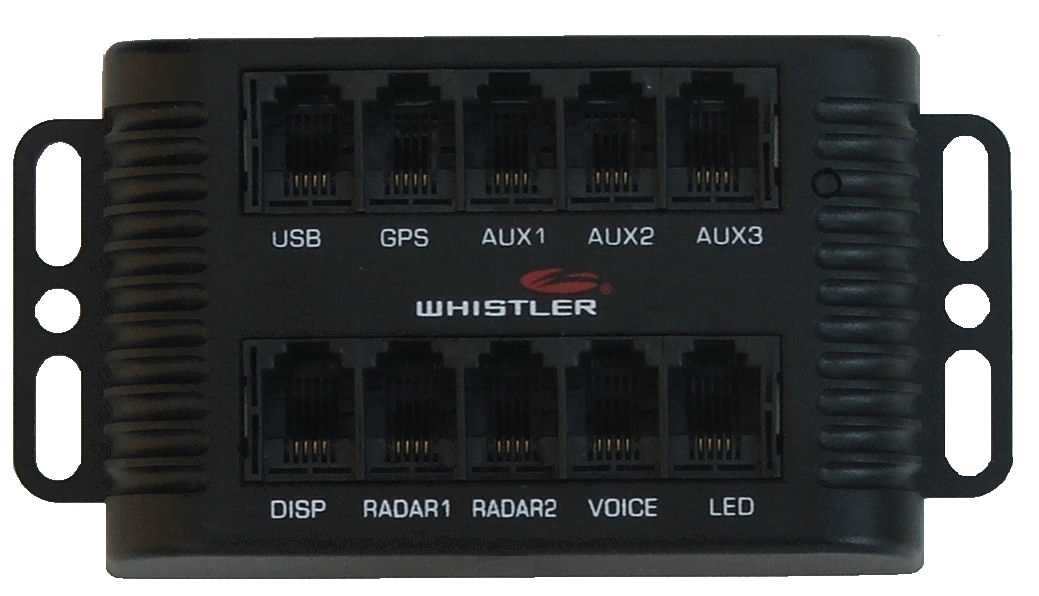
Pro3600 Connection Module

The Pro3600 provides a well-marked connection module with RJ-type connections and an integrated display and control module. The module provides more useful user-customized programming features than any other detector that I have ever encountered (exceeding those of even the V1).

With respect to some of Whistler's unique and especially useful additional features:

The proximity based alerting nature of the photo-enforcement marked locations can be changed from a larger to a smaller radius (which can be useful for heavily monitored city streets, like those found in Washington, DC.) User marked locations can be deleted as a group within a user-selectable radius, or be removed from memory in their entirety.

Another very useful capability, again unique to Whistler, and will be absolutely essential to international drivers, is user selectable and configurable laser pulse sequence windows that enable the Whistler to be able to additionally see and alert to a plethora of European lasers that have pulse-sequences outside the scope of U.S. made lasers. In fact, Whistler appears capable of detecting the Traffipatrol XR, an incredible feat for a radar detector, regardless of brand or price.

One feature, I very much appreciate is the Whistler's ability to obtain live time and date using the GPS NMEA protocol and selectable time-zone and DST offsets. I am not aware of another GPS-enabled detector, that offers this. Having that ability could pave the way for Whistler to offer a lot of interesting new capabilities in the future...

Currently, the 3600 does not automatically account for daylight savings time, and I have already made a request to Whistler's engineering team to consider a firmware update that would enable this capability. This was a timely discovery, as we just crossed into DST. As it stands currently, one must manually enable DST from the menu.

Another aspect of the Pro-3600 I appreciate is the cabling/power fault detection circuitry. When the unit experiences an electrical fault or connection issue of some kind, it alerts with a high-pitched tonal sequence and displays the fault message on the integrated display/control module.

The one-piece display and control module can be mounted in the most-flexible of positions, as the display read-out can be inverted or made to read sideways (for vertical mounting).

The unit has the a GPS odometer and an elapsed travel time log that can be reset, at a push of a button—a handy feature for extended long-distance multi-state trips.

A design element, I don't particularly care for is the speaker attachment. I find its use, to be a distracting element to an otherwise clean and factory-looking professional install. As it currently stands, the speaker module is designed to attach to the A-pillar and comes with an integrated volume control. I generally regard it as an unsightly component, in my particular vehicle.

Separate Volume Controlled Speaker

Furthermore, the speaker never seems to get as loud as the more conventionally designed dashmounts or the high-end remotes from Beltronics and Escort and depending on placement, the visor can be blocked from opening and closing.

My preference would be for the addition of an external speaker box that can be mounted below the dash and out of sight, that has sufficiently high levels of volume to really overcome ambient in-cabin sounds and whose volume can be changed simply by the press of a button located on the main control/display module. Having an extra audio output to feed into car stereo systems could be a nice touch, as well.

I would also prefer to see some improvements made to the audio signal ramp in two areas. Firstly, the audio alert ramp-up to approaching radar sources appears, by comparison to a dashmount SE, to be a bit lethargic. Secondly, the level of urgency of the 3600's maximum alert-rate also appears to lag behind the dashmounts.

Other than these little gripes of mine, I believe the Whistler Pro3600 is a thoroughly thought out and refined package, replete with features and capabilities, not found elsewhere, whose subtle utility become more and more apparent (and appreciated) with each passing day.

Conclusion

Some of you have asked me whether or not, I believe, it is worth upgrading to the Pro 3600 from one of their windshield-mount SE detectors. To this question I must offer a nuanced answer.

I say "yes," if you care to own one remote that provides GPS photo enforcement capability in one package and have a limited budget.

But I wouldn't suggest doing so, if you are merely looking for increased performance to radar as the detection performance of the Pro-3600 appears generally on par with Whistler's existing SE dashmount models.

Pro3600 Radar/Laser Receiver Head Grill Mounting

While Whistler's engineering has informed me that K-band detection has improved a little bit over the dashmount SE models (something that I occasionally noticed), the increase in sensitivity to K was generally offset by the remote's lower grill mounting location (having given up a height-advantage that the dashmount SEs enjoy).

For everyone else, I believe the Pro-3600 is a viable purchase offering a lot of value for those desiring a budget-priced fully-featured remote.

Happy and Safe Motoring!

Get the Veil Guy's articles delivered right to your inbox...subscribe at the upper top left of the page.

Please show your support of the online vendor(s), who support my blog:

Veil Guy

Saturday, August 28, 2010

Whistler Pro-3600 Review

Read the in-depth real-world review: Whistler Pro-3600 Review

Whistler Pro-3600 Review

Updated: 23 Apr 14, By Veil Guy

I've known for some time that Whistler was planning a follow-up to their product line subsequent to their Whistler Pro-68SE release at the beginning of this year's driving season. But what I didn't know was whether the next Whistler model was going to be a dash-mount or a remote.

I got my answer a couple of days ago, when I was informed of the imminent release of the new Whistler Pro-3600 Remote Installed Laser Radar Detector.

First Impressions

The new Whistler Pro-3600 will replace the Whistler Pro-3450, a remote installed detector based-upon the earlier Whistler Pro-73 platform. The Pro-3600 is based upon Whistler's currently highest performing platform, the Pro-78SE.

Those already familiar with the the Pro-78SE platform (and its variants) or with my reviews of the same, will appreciate the performance capabilities of the new Whistler Pro-3600 Remote.

As I have yet to receive a production model with which to drive, I will cover the most salient features that the new Whistler Pro-3600 offers to those desiring to have a high-performance value-priced remote installed radar detector in their vehicle.

The Whistler Pro-3600 provides a nicely sized single display/control module that consists of a red LED display and four (non-backlit) control buttons (two on each side)—power on/off, display brightness, quiet (mute), and city/highway mode.

Compared to other remotes, Whistler's buttons appear to be much easier to use while driving and the display easier to read from a distance. Unique to Whistler, the display/control module can be oriented either horizontally or vertically (including the text orientation), which should increase the flexibility of in-vehicle mounting.
The Whistler Pro-3600 also consists of one interface module (designed to be mounted behind/under the dash), which accepts RJ11 type interface cables. Both the cables and the interface ports are labeled to facilitate easy installation.

The interface module sports three additional AUX ports to provide support for future device attachment (including 3rd party devices), possibly even an active laser jammer and will be field-updatable with a computer and a USB cable.

Another unique and very nice feature (especially for older vehicles) is the use of a cable with the incorporation of a tri-colored (red, green, orange) alert LED at its end. The alert color is user-selectable. What makes this component so interesting is that it will blink RED, when the unit/vehicle is off, making it appear like a in-vehicle security system to a potential would be thief.

The Whistler Pro-3600 is also GPS capable with the purchase of an optional GPS-antenna module. GPS will provide its owner with significant new capabilities, including: traffic camera alerts, real-time speed and direction, trip odometer, elapsed time, user-selectable over-speed alerts, user-selective speed auto mute and filter modes, and support of English or metric units.

With GPS capability, the 3600 can be configured to initially alert at its lowest volume setting while driving at a slower rate than a pre-selected speed. Anyone accustomed to driving around a town littered with X and K-band door openers who finds that even the delayed auto-muting can still be annoying, will appreciate Whistler's solution. A similar speed-sensitive configuration can also be applied to the 3600's filter modes.

Like the Whistler RLC-100 dedicated red light camera detector, the Pro-3600's database can be easily updated with a USB-connected computer, without requiring removal from the vehicle.

Another really compelling feature of the Whistler Pro-3600 is the ability to accept an optional rear-mounted radar antenna/laser receiver. This capability promises to provide Valentine 1-like capability in a remote, the first to my knowledge in any remote installed, regardless of price.

The Pro-3600 provides two distinct signal strength ramps, standard and fast. While both ramps are linear, the fast ramp amounts to essentially a "magnification" of the signal strength. This appears to be similar Valentine's Ka signal-ramp custom configuration setting.

The 3600 adds an additional filter mode, bringing that total to four. Unlike a conventional city/highway mode (which Whistler still provides), these filter modes allow its user to tailor the quickness to alert (ie; the reactivity) to Ka-band. The only other detector that offers anything like this was the high-end (and out of production) Beltronics STi-R.

Like most Whistler SE models, the Pro-3600 provides Ka RSID. The Pro-3600, however, now augments the RSID display with voice prompts, as well.

Installation time, I understand, can be as little as 30 minutes. Obviously, times will vary depending on the particular vehicle and the skill-set of the installer.

Retailing at $479, the Whistler appears to have another winner on its hands with the Pro 3600 especially when one considers its PRO-78SE-like performance, that GPS capability can be added for $99, one can add a rear antenna (for what I can't imagine being more than $149), and has the ability to integrate with 3rd party devices/systems.

Some companies pre-occupy themselves with releasing entirely new products peppered with catchy marketing phrases without offering much underlying substance.

Whistler, on the other hand, charts a different course. With each of its new product offerings, its commitment to continuously improving...to refining...to evolving is evident.

While a number of the new features mentioned above aren't strictly performance related, when they are taken in their entirety, they result a detector that is refined, mature, and synergistic—the whole is greater than the sum of its individual parts.

I am definitely looking forward to installing this new Whistler Pro-3600 into my wife's 'Bru.

Tuesday, March 02, 2010

Whistler Pro-68SE Review: Whistler's Economic Stimulus Package


Whistler Pro-68SE: Latest High Value/High Performing Radar Detector from Whistler

Updated: 23 Apr 14, By Veil Guy

For the 2010 driving season, Whistler continues in its tradition of offering honest high performance radar detectors—to drivers on a budget—with the introduction of their new model, the Whistler Pro-68SE.

For those of you already familiar with Whistler's SE models which appeared last year (see: XTR-690SE, XTR-695SE, PRO-78SE review), the Whistler Pro-68SE sports the same improved case as these higher-end models, provides a slightly lower feature-set, and the identical performance of their revered Whistler Pro-78 Rev C (review).

The Whistler Pro-68SE provides a simplified display screen that is divided into two regions, the left containing display icons of band identification (the same as the earlier model Whistler Pro-68) coupled with the right side which consists of a blue LED indication of a numeric signal strength and reception mode (ie; City, Highway). Unlike the Pro-68SE's more expensive siblings, this budget-priced radar detector does not include voice modes or selectable alert-tone configurations.

The Pro 68SE also does not provide the Ka Max mode feature available on these other higher-end and consequently more expensive radar detectors, but like the Pro 78 Rev C, Ka reception performance does improve when POP detection mode is turned off.

Of course, this model does retain the extremely quick-responsive nature to brief appearances of radar that are common in QT (quick triggered instant-on radar) and reflected radar of longer duration instant-on or constant-on use that routinely occurs while your vehicle is in motion while not excessively "falsing" as a consequence and provides a variety of filter-modes to further fine-tune this delicate balance between quickness/sensitivity and selectivity.

Furthermore, Whistler continues to provide detectors which provide superior conveyance of approaching instant-on threats and accurate proximity warnings to unseen police radar threats, as well as a more useful "trailing-alert" duration when police radar is no longer actually present—features that I consider essential in any good radar detector design and something that really is only matched by the mighty Valentine One, the legendary radar detector retailing at $399.

Although this new model is based upon the existing Pro-78 Rev C, it's laser detection sensor is more sensitive, since it comes from the newer 690SE/695SE/Pro-78SE models of last year.

Retailing at $169USD, its street price will be somewhat lower, making this new Whistler one of the great radar detector values. I will provide a more comprehensive evaluation when they begin shipping in mid-March.

For those seeking a terrific performing radar detector, but who are on a tighter budget (aren't we all?), this new radar detector is a most compelling driver's companion—think of this new model as Whistler's economic stimulus package.

Happy and safe motoring!

Further reading (online discussion):

Pro68SE discussion

Veil Guy

Sunday, May 03, 2009

Whistler Pro 78SE, XTR-695SE, XTR-690SE Review

New for 2009: Whistler Pro78 SE, Whistler XTR-690SE, Whistler XTR-695SE

The SE, may officially stand for Special Edition. But, what it really stands for is MAX(imum) Ka Performance

I am very pleased that the much anticipated new Whistler Pro-78SE, Whistler XTR-690SE, and Whistler XTR-695SE models will soon be making their way to your favorite radar detector retailer.

For 2009, these three related Whistler radar detector models are especially noteworthy for their improved Ka and laser reception performance.

As has been the case in the recent past, Whistler has afforded me the privilege of an advanced look at their new flagship model line-up.

I have taken each of them for an extended drive and pitted them against a bunch of real-world traffic enforcement to ultimately determine how improved the new Whistler XTR-695SE, Whistler XTR-690SE, and Whistler Pro-78 SE models really are.

Were they worth the wait? Well, here's what I found:

Whistler Review: XTR-695SE, XTR-690SE, Pro-78SE

Veil Guy

Saturday, June 28, 2008

Whistler XTR-695 Review: Best Whistler Radar Detector Yet.

As some of my close readers already know, I have been fortunate to have been able to conduct a long-term review of the new Whistler XTR-695, previewed by myself, some time ago.

After a number of months of driving and many thousands of miles with the new Whistler XTR-695, I am pleased to be finally able to share my realworld experiences with this fascinating new radar detector from Whistler.

The Whistler XTR695 sports some new features—not yet seen in a radar detector, regardless of price—which should be very appealing to hardcore radar detector enthusiasts.

Whistler XTR-695 Review

I hope you guys find it to be an informative and detailed look into this new Whistler windshield-mount radar detector.

Trusted Purchasing Sources:
Related Videos:
Veil Guy

Tuesday, April 01, 2008

Whistler XTR-695 Review/Preview


Update 23 May 09: Read about the new and even higher performance Whistler XTR-695-SE

Update 01 Sep 08: Full Review at Whistler XTR-695 Review

Whistler XTR-695 Radar Detector Formally Announced Today

I am pleased to report today Whistler Group has announced its continuing commitment to producing top-performing radar detectors while sporting unique feature differentiators at modest price points.

Whistler's latest radar detector offering is the Whistler XTR-695. Whistler has taken the best of the XTR-690/Pro-78 Rev C. platform and added some truly unique features.

With the XTR-695, Whistler now offers two new exclusive reception alerting capabilities: Ka Radar Signature ID (RSID) and Laser Signature ID (LSID).

Whistler has decided to help take the guess work out of police radar gun identification and instead indicate only the well-established Ka police radar frequencies approved for use.

In the case of Ka-band police radar, the Whistler XTR-695 RSID can identify the nominal frequency of the police radar gun that is being used to target you.

In the very wide Ka police radar band this amounts to six frequencies: 33.8Ghz, 34.0Ghz, 34.3Ghz, 34.7Ghz, 34.9Ghz, 35.5Ghz (34.0Ghz and and 34.3Ghz are used primarily abroad, while 34.9Ghz appeared on some "early" Ka police radar guns).

When it comes to police laser (police lidar), the Whistler XTR-695 is the only laser detector that will display the actual police laser's pulse-rate (PPS rate).

This will educate the driver to the PPS rates of police laser guns being used as each manufacturer's lidar gun is built to perform at a specific pulse-rates such as 100/125/130/200/238/380/600.

Beyond merely identification, the XTR-695's LSID enables another truly unique and welcomed feature —that is selective "squelching" or muting of certain laser alerts based upon the detected pulse-rate.

Whistler is being very forward thinking on this capability which should provide greater utility in the future as more and more laser-based automotive systems flow into the market. This includes, but is not limited to, LED type tail-lights and brake-lights, laser-based adaptive cruise control and lane departure systems, any of which have the potential to wreak havoc on radar detectors with sensitive laser detection.

This "lock-out" feature enables the Whistler XTR-695's owner to "mute" laser alerts from up to 10 of these systems +/- 10% of the identified pulse-rates.

If your travels routinely take you by airports, you will now have the ability to mute falses from the laser-based wind shear detection systems that can routinely set-off sensitive laser detectors. Before setting a lock out rate you should first determine if it is within 10% of known police lidar.

Ergonomically, Whistler has a number of rewarding enhancements for discriminating drivers concerned about aesthetic continuity within the environs of the driver's cockpit.

The XTR-695's LCD can now be programmed to display seven back-lit colors: two shades of green (light/med), three shades of blue (light/med/dark), one red, and one purple. This should enable the 695's owner to match the display to virtually any interior lighting scheme.

The Whistler XTR-695 can also be programmed to visually alert differently to varying police radar bands using any of the seven colors or a sequenced pattern of all seven colors.

Another welcomed and novel design element of the Whistler XTR-695 is a low-glare housing is designed to reduce/eliminate sun-glare and minimize its mirror reflection on the windshield.

The Whistler XTR-695 features an audio jack which will enable the radar detector to be potentially integrated into other related devices such as Cheetah's GPSmirror red-light camera and speed camera detection systems.

Like the Whistler XTR-690, the XTR-695 provides both compass and voltage information.

The MSRP for the XTR-695 is $249USD with the street price expected to be somewhat lower.

As with other Whistler top radar detectors, you would be well advised to purchase this new detector only from an authorized dealer who adheres to Whistler's established MAP policy to ensure that Whistler's generous three year warranty is not voided.

I am looking forward to getting some "seat-time" with this capable radar detector and providing a more formal follow-up review.

In the meantime, I again offer the fine folks at Whistler Group, mega-kudos for not resting on their laurels and for continuing pushing the performance envelope with their product offerings. I anticipate more great things from this enterprising organization!

You're welcomed to join the discussion of this exciting new radar detector: Whistler XTR-695 Announced

Update: 27 JUN 08: Formal review can now be found at: Whistler XTR-695 Review

Happy and Safe Motoring!

Trusted Purchasing Sources:

Related Reading:

Related Videos:

Veil Guy

Friday, October 26, 2007

Whistler Pro 78/ Whistler XTR-690 Updates Finalized

I am pleased to report today that the Whistler Group has finalized their enhancement updates to their venerable Pro-78 and XTR-690 top-of-the-line windshield-mount radar detectors and have generously decided to make these updates available at "cost" for existing Pro-78 and XTR-690 owners interested in having their detectors updated to the latest "REV C" firmware code.

To be clear, this update is entirely an elective one best suited for the "road-warrior" or "hard-core" radar detector user, as either of these radar detectors provide top-end performance in their current form.

Rev C provides the following enhancements:

Ergonomic:

Improved auto dimming function
Police laser voice alert sequence now in line with radar voice alert sequence
Added slight display hold to brief alerts to allow visual confirmation

Performance:

With POP OFF, improvement, most notably, to radar reception of USA bands (33.8Ghz, 34.7Ghz, 35.5Ghz) and European bands (34.0Ghz, 34.3Ghz), Gatso, and the polarized radar sources of Multanova and RAMET.

According to the Whistler Group:

Rev C has been released for the Pro 78 and XTR 690 and developed for our
international customers that do not require POP and wish to take
advantage of some performance increases when in the POP OFF mode.

It is Whistler's strong suggestion to operate the unit in the POP ON mode
for the USA and as such, the software changes will make no performance
difference vs. the previous revisions when operated in the POP ON mode.

The changes are not essential to the USA market however we will offer
the Rev C to our USA consumers that desire it.

There will be a flat fee of $20 to upgrade to Rev C to cover the cost of
the upgrade, process, and handling.

USA customer units will be returned with the same [shipping] priority that they were received with the return shipping charges paid for by Whistler.

International customers will be returned via USPS (typical 2-3 week return delivery).

In order to have your unit returned to you quickly and to evenly distribute this process across two locations, Whistler asks that Rev A units be sent to the Massachusetts address and the Rev B units be sent to the Arkansas address.

The Rev can be checked by holding the city button then applying power to the unit.

Rev A Units Send To:

Whistler Product Development
168 Ayer Rd.
Littleton, MA. 01460

Rev B Units Send To:

Whistler Repair Center
551 North 13th Street
Rogers, AR 72756

Please be sure to include with your unit; your name, address, phone number, email address and a cashier's check, money order, or credit card information to cover the $20 fee.

I would personally like to thank the folks at Whistler for being as responsive and as dedicated to supporting their customers in the manner in which they have.

For a nominal and very reasonable fee (as compared to other manufacturers), we hard-core Whistler fans have the ability to extend the performance life of our Pro-78 and XTR-690 radar detectors without being forced to purchase an entirely new model.

Please join me in expressing your thanks to Whistler for providing the highest levels of customer support!

Veil Guy

Monday, July 16, 2007

Whistler Pro 78/ Whistler XTR-690 Update, Update

Given the recent buzz about Whistler's new radar detectors, in the wake of our review, there has been some mis-understanding about the availability of the new code developed by the engineering team of the Whistler Group that I wish to correct, for the record.

While it is true that Whistler is making improvements to the code to address some of the subtle issues we pointed out and to further squeeze some more performance out of their new platform, they are taking their time with it as they are going to do it right, instead of fast—it is still in the beta testing phase.

When the new beta code has passed all the QA testing, we will be the first to be notified as to when the revision will become available and then so shall you.

It is a rare pleasure to behold a company so openly committed to improving their product(s) for the sake of satisfying their customers—they've made me a fan.

In the meantime, you can be confident that any purchase of either the Whistler Pro-78 or the Whistler XTR-690 can be easily updated at the appropriate time, so there is no need to delay being protected by either radar detector by waiting for the update (realize, the majority of our review was based upon the original models).

Keep posted, as we will be the first to report when the update becomes generally available and please don't contact Whistler directly—about this issue—as doing so will only serve to slow them down.

Thanks.

Veil Guy

Sunday, July 01, 2007

Whistler Pro-78, Whistler XTR-690 Radar Detector Update II

I NEED COUNSELING. I know this because, I've been obviously addicted to testing radar detectors every spare moment I have, lately.

While putting on another 350 miles today on a variation of my usual Northeast route, I couldn't help but feel a connection to another product tester of "similar sorts" (yeah right)— retired Brigadier General Charles Elwood "Chuck" Yeager.

He too field-tested new products, albeit at a somewhat higher rate of speed, than say a '07 BMW 328xi (which by the way, is one of the best cars I have ever driven). I can only imagine the fun he had in his experiences—since he never managed to kill himself testing various new hyper-speed aircraft.

chuck yeager testing the Bell X-1
Chuck Yeager testing another Bell model (X-1)


This weekend didn't start out too well, I am afraid. During a drive to southern NJ (while testing, of course), I damaged all four sport alloy rims and several tires— on my Dinan 540—driving through a construction zone on south I-95 approaching Route 322-East in Chester, PA. The road surface was not even and by the way the impact felt (abrupt), the difference in road surface must have been at least an inch between two slabs. It's a testament to how well Michelin Pilot Sport tires are made that they didn't blow out right then and there. I'll post some pictures of the damage soon. In the meantime, I had to settle for an '07 328xi to be the test-mule this weekend.


At any rate, I did manage to sneak some testing in today with the updated models (with the beta firmware) that I received from the Whistler Group (www.whistlergroup.com)— the revised Whistler Pro-78 and Whistler XTR-690 radar detectors.

All I can say is Mr. B. (or should it be Dr.?) and his engineering staff know what the hell they are doing, because inside of one week (since my review of the Whistler Pro-78 and Whistler XTR-690 radar detectors), they have managed to take a great radar detector and make it even better!

Ergonomically, the pulsating auto-dimming issue has been resolved as has the too rapid display alerting relative to the audible alert. This revised radar detector now handles a rapidly changing lighting environment better than the Beltronics STi Driver.

To test Whistler's radar reception improvements (with POP OFF) required me to find three known bona-fide stationery steady-state radar sources at X (10.5Ghz), K (24.1Ghz), and Ka (34.7Ghz). Since my original radar Whistler radar detectors were sent back to the Whistler Group to have them reprogrammed (I am told the same courtesy will be extended to any existing Whistler owner of the Pro-78 & XTR-690 who wish to have their unit updated), I made repetitive back-to-back two-way comparison runs between my model with POP ON versus POP OFF with each one of these radar sources.

Here's what I found:

  • With X-band, the performance pick-up was imperceptible.

  • With K-band, the performance pick-up was noticeable.

  • With Ka-band (34.7Ghz variety), the performance pick-up was quite noticeable.


Particularly with Ka from the front, when compared to one of the Bel STi Drivers, when POP was OFF, the Whistler Pro-78 tended to be the first to respond, even if only by a tick or two. Yes, you read that right, first. On one such pass, the Whistler Pro-78 appeared to initially mis-identify the weak glimpse it had of Ka-band and alerted to X-band, releasing, and subsequently reporting the proper band of Ka (of 34.7Ghz).

Note: I have occasionally received weak 'false' x-band alerts on the highway from the Whistler Pro-78 while the Bel STi Driver has remained silent. Base-upon the aforementioned experience, I suspect these falses were actually weak Ka that were mis-identified.

Apparently, the reason the performance differences on X-band and K-band aren't as noticeable is rooted in the wave-propagation characteristics of those frequencies/wavelengths relative to Ka-band and not so much the radar detector, itself.

After closely watching this Whistler Pro-78 do its thing, I noticed something for the first time, subtle as it is, but it was new [to me] nonetheless. It appears that Whistler Pro-78 has two distinct single alert ramps!

And, in my opinion, the best [and quickest] visual alert ramp I have ever seen on any radar detector, regardless of price. In fact, the visual strength indicator is so quick and precise, it feels more like the old analogue signal strength meter of the original Escort radar detector of the eighties, remember that one?

The Whistler Pro-78 visual strength indicator—although a digital LED—acts more like a PEAK meter than a VU meter (which is slower and less precise) like every other radar detector— its five main display elements can display fractionally which amounts to a total of 15 discreet signal strength bars.

If you carefully watch the display during a steadily approaching radar source, you will notice that the display will move faster up-and-down than the tone alerts.


See the resemblance between Whistler and Vaal?


I also found that when I operated the Whistler Pro-78 with POP ON, the radar detector tended to false [to other radar detectors] more than when the Whistler Pro-78 was operated with POP OFF—at which time it was extremely false-resistant.

Therefore, my recommendation for operating this radar detector is with POP OFF, SWS OFF, and no additional filter modes enabled—just the FILTER display.

As counterintuitive as it sounds, you'll actually be able to drive with a more sensitive and quicker radar detector which actually falses less. Now that IS having your cake and eating it too.

Each passing day I drive with the Whistler Pro-78, I come to know that at a retail of $229, it's the bargain of the century and at a street price of $179, it's the steal of the century. The same goes for the Whistler XTR-690 which provides identical radar/laser reception performance.

If I had to ever show up to a gun-fight sporting my Whistler Pro-78, I know I could more than hold my own with it.

I would like to think had General Yeager been riding shotgun, he'd be having some fun recollecting his past trials and tribulations in the cockpit with me, although, I know in my heart—if he had been in the car—he'd be doing the driving!

Veil Guy